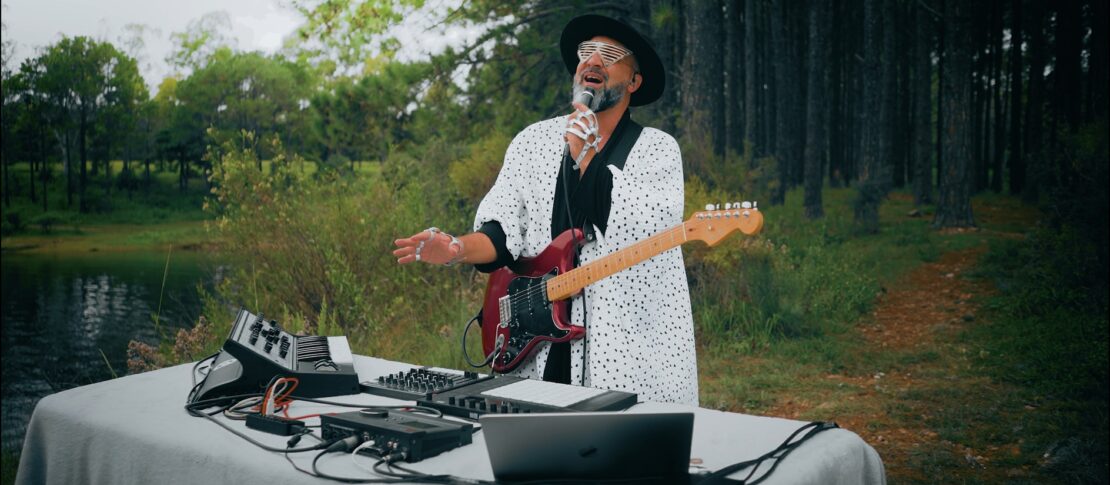
Chudy: Where Sound Meets Story
In this interview, artist and producer Chudy reflects on his creative journey shaped as much by storytelling as by sound, his workflow and stand-out projects. With roots in cinema, his work is driven by a strong sense of narrative, emotional timing, and structure – qualities that continue to inform his approach to both performance and production.
Trained in classical voice, guitar, and contemporary composition, Chudy has developed a deeply personal sonic language. From early experiences of artistic independence and experimentation to building a life across countries, Chudy’s path has been defined by a commitment to authenticity and exploration. Today, his practice spans live performance, studio production, and electroacoustic experimentation – each feeding into a unified creative ecosystem.
Hi Chudy, thanks for taking the time to speak to us. Could you please describe your studio space in a few sentences?
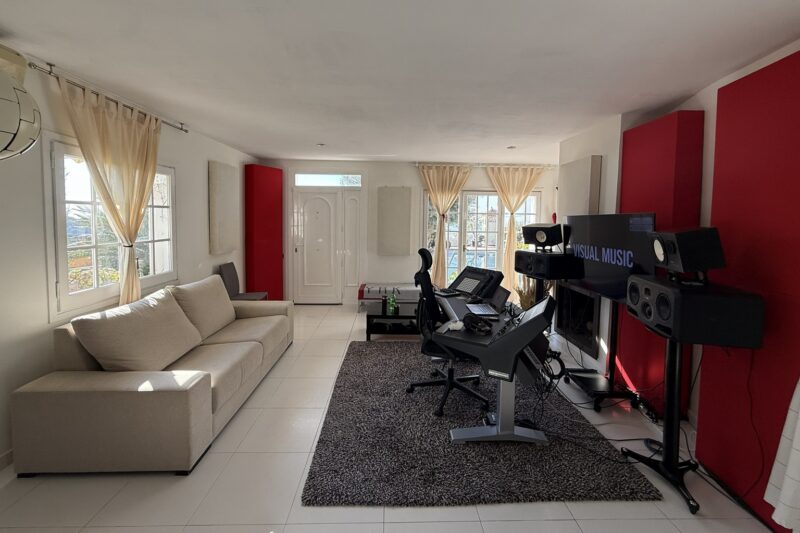
“My studio is called ‘Visual Music’ and it is a creative space, lab, and hub located on the coast near Barcelona, surrounded by mountains, nature, and open views to the sea. After years of working in large studios, electronic music environments, and studios inside major venues, I decided to create my own space. Something more personal and intentional.
The space is designed for immersion. Silence, birds in the morning, natural sound throughout the day. Everything is aligned to support deep listening. It’s not just about working here. It’s about entering a different state.”
Chudy’s describes his daily workflow as shaped by a balance of structure and intuition, deeply influenced by his environment and creative rhythm. His mornings, often beginning in silence with a simple ritual like preparing coffee or mate, are dedicated to pure creation like exploring ideas, revisiting sketches, and experimenting with sound through instruments and production. As the day progresses, his studio shifts into a more collaborative and technical space, where mixing, mastering, and global coordination with artists and teams take focus. He maintains flexibility through a carefully managed yet adaptable schedule, allowing him to protect creative flow while meeting professional demands.
Equally important to his process are moments of pause and movement. Taking a step back from a project to get outside, to change listening environments, or to find inspiration in travel, nature, and performance is key to staying inspired, focused and motivated. The interplay between studio work and live experience informs his sonic perspective, while continuous exploration of sound remains at the core of his creativity.
What projects are you working on currently or have you finished recently that you would like to tell us about?
“Right now, I’m working on an album with a traditional percussion school in Panama, which has a very strong rhythmic identity and cultural depth.
In the past months, I completed the post-production of Zaatari, a project recorded in a refugee camp, with a powerful emotional and social dimension.
I also finished mixing and mastering an album recorded in Morocco, which is not yet released, along with multiple singles produced across different regions of Africa and Central America.
In parallel, I’m developing my own music and audiovisual content. Including live electronic performances recorded in natural environments, like a recent set in the mountains of Cordoba, Argentina.”
Chudy maintains balance by structuring his professional and artistic work around a clear core: his live performances. Operating independently, he combines flexibility with discipline, prioritizing his own music while selectively collaborating on projects that align with his personal vision. His studio, productions, and performances all feed into the same creative ecosystem, and therefore constantly influence one another.
Your work on “African Strings” caught our attention some time ago. How did you approach mixing and mastering this particular album?
“’African Strings’ was a post-production project that I developed through a commission with an international foundation working across different regions of the world. The album is a collection of recordings made in various African countries, featuring musicians captured in very diverse and often non-traditional environments.
My role was to receive the material, request corrections when needed, coordinate the delivery of multi-tracks, and then handle the full mixing and mastering process until the final release.
Many of these recordings included complex rhythmic structures, unfamiliar instruments, and strong cultural identities. Often, I was hearing these sounds for the first time. That required a deep process of listening, researching, and sometimes communicating with the artists to better understand the context. From a technical perspective, the approach was clear: preserve the truth of the recording. If the capture is honest, the monitoring has to be even more honest. The goal was never to transform the material, but to reveal what was already there.”
Speaking of studio monitors, or equipment in general: what are your studio essentials?
“My setup has evolved a lot over time. Traveling made me simplify everything and focus on what truly matters. At the very center are my S3H midfield monitors. They are my main point of reference. In terms of microphones, I use a good selection of Manley Reference, Neumanns and AKGs, along with 500 series preamps and a UA La 610 mk2. My interfaces are Antelope Audio Orion Studio Synergy Core in the studio and Zen Tour Synergy Core on the road. I also use my ZOOM H1n small portable handheld recorder to capture sounds in nature.
Another essential element is the room. Even simple acoustic treatment, bass traps, panels, and rugs are fundamental for accurate monitoring. Over time, I realized that a clean signal chain, good conversion, and precise monitoring are more important than having a lot of gear. Everything comes down to how accurately you can hear what you’re doing.”
When you are starting a new track, what do you pick-up first – the laptop or your guitar (or any other instrument)?
“It depends on the moment. Sometimes I start with guitar or synthesizers, following a more intuitive path. Other times, I go directly into the computer and begin with production or sound design. I like moving between these two approaches, organic and technological, and that interaction is at the core of my sound. But more than the instrument itself, what really defines how I start is the state I’m in. In the mornings, I usually wake up with a very active mind, full of ideas. I try to protect that moment. I avoid checking my phone or consuming information, because I’ve realized that doing so can easily take away hours of creative energy. So, the first thing I actually connect with is silence. That space allows ideas to emerge naturally, without interference.
If the ideas feel more abstract, I tend to go to synthesizers, (like a Sub 37 or a DX7) where I can explore textures and sustained sounds without thinking too much. If the impulse feels more direct or emotional, I pick up the guitar. And in almost every case, I start by singing. Even before playing anything, I use my voice to translate those internal ideas into something real.”
Final question for you: Do you have any tips or recommendations for people who are just starting out?
“Focus on what you actually use every day. You don’t need a complex setup to start; a laptop and a DAW are enough. But when you invest, do it step by step.
Monitoring is key. It’s your daily reference. Then come converters, microphones, and preamps. Building your system progressively. Understanding what you hear is more important than having more gear.”
Thank you very much for your insights, Chudy!
Follow Chudy on Social Media:
Top Posts
You might like
-
Built by Rebels: Plugins by Audified
Audified, originally founded as DSound in 1998, gained its first major success with the pioneering Stomp’n FX guitar pedal software, establishing early expertise in instrument emulation. Over time, the company expanded its portfolio with products like the Amplion guitar rig – introduced ahead of many modern competitors – and collaborations…
-
Tobi Mark delivers Precision Under Pressure
How Georgia-based live sound engineer Tobi Mark builds reliable productions and broadcast-ready mixes with ADAM Audio studio monitors. In live production, clarity is everything. For Tobi Mark, live sound engineer and founder of Markex Productions, delivering consistent, professional audio is both a craft and a responsibility. “I…