Hi-Fi Speakers vs Studio Monitors – What’s the difference?
If you’re reading this blog post it’s a reasonable assumption that you own a pair of professional monitors and they’re installed in your studio; be that a bedroom in your house or a generously equipped high-end control room.
But in your living room, in the kitchen or perhaps in the studio reception area, you might also have a pair of hi-fi speakers. Just like your professional monitors, the hi-fi speakers probably claim to offer high performance and accuracy, but are professional monitors and hi-fi speakers in any respects fundamentally different? Speakers designed for domestic hi-fi and those designed for professional monitoring clearly have much in common in terms of their basic architecture, but there are differences in the way they’re conceived and designed. So, in this article we’re going to investigate what those differences might be and how they might influence the speaker’s performance.
Two different worlds?
Considering just how many well established manufacturers of high performance speakers exist across the world, and considering how much commonality there is in the design and production of hi-fi speakers and pro monitors, there’s surprisingly few manufacturers that have significant presence in both the domestic and the professional sectors. There’s a number of reasons for this; some of them are commercial (the domestic and professional sales channels for example are different) and some of them a result of the specific engineering and design DNA of the manufacturers. But imagine for a moment you are responsible for product development at a speaker company that operates in both the professional and domestic sectors and you’re tasked with managing the design of a mid-market professional nearfield monitor and a mid-market hi-fi speaker.
Active vs passive
Perhaps the first thing you’ll need to consider is that while professional monitors are almost exclusively active, with internal power amplification, hi-fi speakers are still generally passive; driven by external amplifiers. The reason for this is partly tradition and partly the different sales channels we mentioned earlier. The domestic hi-fi retail business is still substantially built on selling discrete source, amplification and speaker products, and while there are increasing numbers of active domestic speakers, the majority remain passive. One of the arguments often made in favour of passive speakers in the hi-fi sector is that the active configuration is inherently more expensive because multiple power supplies and more channels of power amplification (one for each driver) are required.
This was probably true back in the days when active speakers of any kind were a novelty, but it is becoming less so. Switched mode power supplies and class-D amplifiers have reached levels of performance comparable with conventional electronics comprising expensive linear power supplies and class-A/B amplification that demand generous aluminium heatsinks. Furthermore, the complex crossover networks necessary for a passive speaker to reach genuinely high performance levels are far from inexpensive. This is because, in operating at power level rather than line level, the inductors and capacitors used to implement the crossover filters need to be able to withstand high voltage levels and to pass high currents. They are large, heavy and expensive as a result. Despite this however the active principle is still uncommon in the hi-fi sector, except among speakers that incorporate integrated network and streaming functionality.
Positioning matters
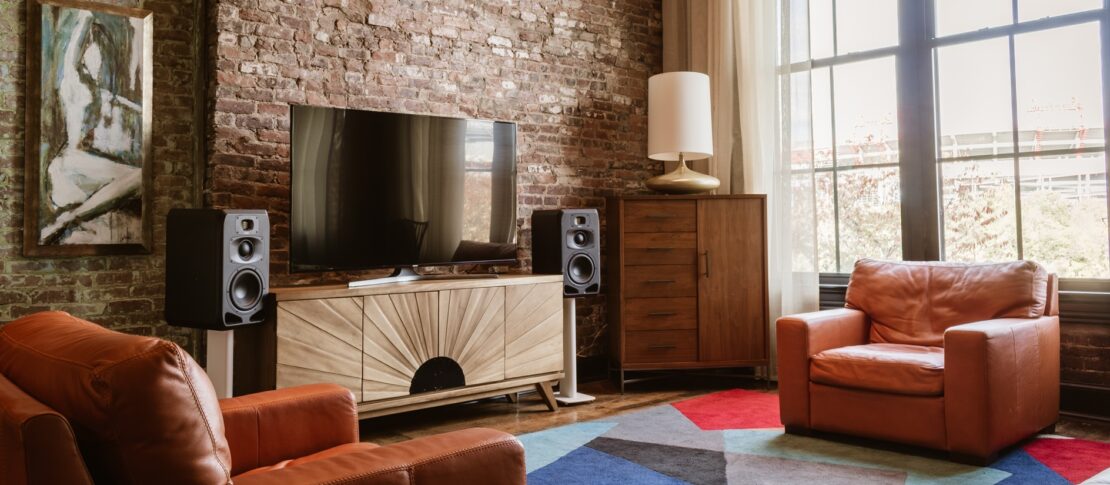
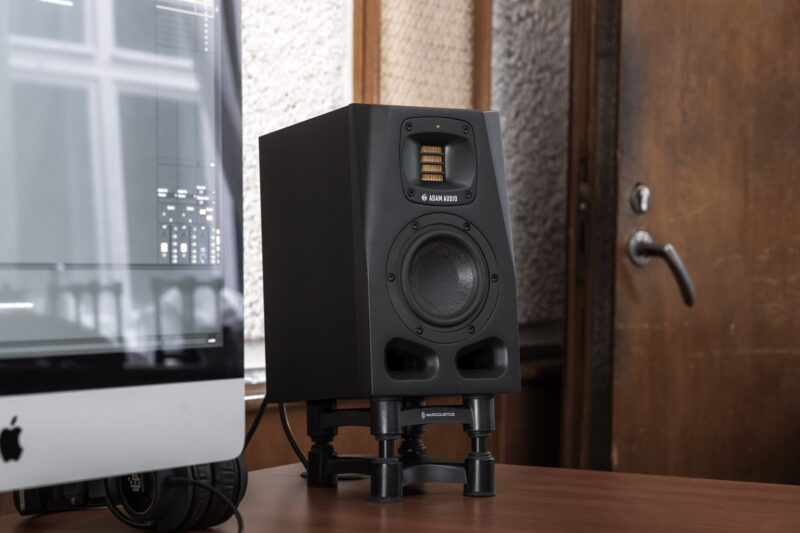
Next in your product management role you might consider how each type of speaker will be installed. In the case of the professional nearfield monitors they will most likely be installed on the meter bridge of a large format mixing console or on a monitor shelf above a workstation desk. The room in which they are located will likely be at best professionally acoustically treated or at least include some measures designed to control the reverberation time. The domestic hi-fi speakers however will be installed perhaps on speaker stands or on wall shelves in a living room or other domestic space where the inherent acoustics are unlikely to have been modified in the interests of audio performance. The reverberation time might be very short if the room is full or soft furnishings, carpets and curtains, or decidedly long if the room is un-carpeted and generously blessed with windows. The result of this is that when you come to make decisions on the subjective tonal balance of your hi-fi and pro speakers, the neutrality (i.e. flat response) you will want from the pro speaker might not be most appropriate for the hi-fi speaker.
Looks, features and “snake oil”
In your position as product manager you’ll also have to consider the finish quality of your hi-fi and professional monitor speakers. Where hi-fi speakers generally fall into the luxury purchase category, professional monitors are tools designed to do a critical job. So customers’ needs and expectations in terms of material choices and finish quality are different. A professional monitor speaker cabinet for example is typically finished functionally in dark textured paint or laminate, but a typical hi-fi speaker cabinet is finished in fine real wood veneers coated with a satin or even high gloss lacquer. The veneer might even be matched across a stereo pair of cabinets. And it’s not just cabinet veneers that are required to surprise and to delight the hi-fi customer, every visible component of a hi-fi speaker needs to speak of a luxury finish – screws and bolts with bright chrome plating, aluminium panels with faultless lacquered anodising, and plastic components finished with high-tech soft touch paints. So the quality of finishes required on a hi-fi speaker are expensive, and that unavoidably impacts on the proportion of the manufacturing budget available for components that actually contribute to the acoustic performance.
Falling into a not dissimilar category as finish quality, the domestic hi-fi sector is somewhat burdened by a fixation on features that for many fall into the category of, ‘snake oil’. In the case of hi-fi speakers such snake oil might comprise unconventionally engineered (and expensive) internal connection cables, esoteric crossover components or massively over-engineered connection terminals. Despite their typically unproven electro-acoustic benefits such features can become obligatory for marketing purposes even though they consume manufacturing budget that might be better spent on components that offer proven performance benefits.
Neutrality vs character
Finally in your project manager role you need to consider what subjective audio character is appropriate for a hi-fi speaker and a professional monitor. Answering that question is relatively straightforward for a professional monitor, because ideally a professional monitor should have no character of its own at all. Within the constraints of the budget available for the functional components and their engineering, a professional monitor ought to be engineered to provide as flat a frequency response as possible, offer minimal distortion, compression and resonant colouration, and display dispersion characteristics that will be compatible with the likely acoustic characteristics of the listening environment and listening distance.
It could hardly be a more different story in the hi-fi sector because rather than engineering a speaker to be faithful to the input signal, the hi-fi speaker designer’s job is to ‘voice’ the speaker (primarily using passive equalisation engineered into the crossover filters) so that it will sound engaging and seductive for the listener (especially in a retail demonstration context), work successfully in a wide variety of domestic environments, and be competitive in terms of sensitivity and low frequency bandwidth. And the hi-fi designer has to do all this with comparatively less budget available for the acoustic engineering because so much has been committed to finish quality.
Conclusion
This all raises a question that’s regularly asked in professional audio online discussion forums: “can hi-fi speakers be used for professional monitoring?”. The answer is that while any speaker can in theory be used as a monitor, using a hi-fi speaker rather than a professional monitor will be a gamble because, for all the reasons described above, the hi-fi speaker is likely to offer a lower level of inherent performance and is less likely to be tonally neutral. The results might be that your mixes are not fully optimised and they won’t translate so effectively to other playback systems. The unique signature of the hi-fi speaker will be imprinted on them. But there is of course also an opposite question to consider: can professional monitors be used for domestic hi-fi purposes? The answer here is that yes, they very much can. If you’re happy to live without an external power amplifier, the real wood luxury finish of a hi-fi speaker cabinet, the over engineered connectors and exotic crossover components, a professional monitor might very well bring your listening for pleasure closer to experience the artist intended. And that’s got to be a good thing, right?
Video: How to set up your Studio Monitors for Hifi Listening
By loading the video, you agree to YouTube's privacy policy.
Learn more
Top Posts
You might like
-
Active vs. Passive Loudspeakers – What’s the difference?
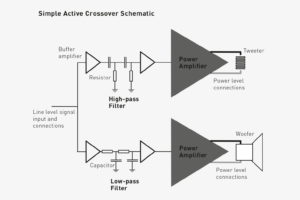
Despite the fact that the majority of loudspeakers designed for studio monitoring, including all ADAM Audio studio monitors, are active, the world of consumer hi-fi is still dominated by passive loudspeakers. So, in this blog post we’re going to unpack the differences between active and passive loudspeakers, and unpick some…
-

Balanced vs Unbalanced Audio Connections
Consumer and professional audio systems have much in common. The fundamental technologies of professional studio monitors and hi-fi speakers are, for example, not really so different. But there is one respect in which professional audio systems in studios diverge fundamentally from most hi-fi systems in the home, and that’s the…