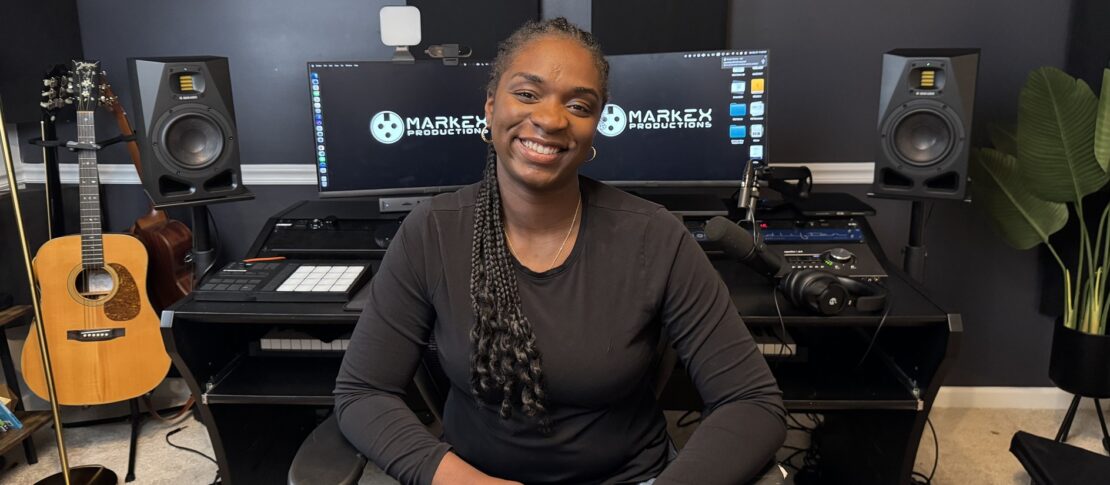
Tobi Mark delivers Precision Under Pressure
How Georgia-based live sound engineer Tobi Mark builds reliable productions and broadcast-ready mixes with ADAM Audio studio monitors.
In live production, clarity is everything. For Tobi Mark, live sound engineer and founder of Markex Productions, delivering consistent, professional audio is both a craft and a responsibility.
“I first got into live sound through my church when the lead engineer transitioned out and there was a clear need for someone to step up,” she explains. Already a musician – playing guitar, piano, and drums – she was naturally curious about how sound worked and how to improve it. “I was intimidated at first, but I saw it as an opportunity to grow.”
That willingness to grow laid the foundation for a career in professional live sound engineering, broadcast mixing, and audio education.
Music has always been central to her life. “It has been one of my main ways of expressing emotion, communicating stories, and connecting with people.” Whether mixing a church service, corporate conference, concert, or broadcast stream, her mission remains the same: “to remove barriers and allow people to fully engage with what they are hearing.”
After relocating to Georgia in 2018, she began receiving requests for technical consulting and training from organizations across multiple states. In 2021, she officially launched Markex Productions, transforming her freelance work into a full live sound production company.
Today, Markex Productions supports weddings, conferences, outdoor events, concerts, and broadcast productions. Beyond that, Tobi has built a growing online presence as an audio educator. Her social media platforms have expanded her reach nationally, increasing demand for consulting, training, and technical support.
Live Sound Strategy: Preparation, Redundancy & Stability
In live production, technical issues can arise at any moment. Tobi’s approach focuses on minimizing risk before an event begins. Her workflow includes detailed system design, organized signal flow, documentation, and built-in redundancy. She travels with spare cables, backup microphones, and essential tools. Team coordination and clearly defined roles further reduce risk.
“When unexpected issues do arise, I remain calm, diagnose the problem efficiently, and implement solutions without disrupting the audience experience,” she says. “My priority is always stability, consistency, and maintaining the quality of the production under pressure.”
Building a Professional Home Studio for Broadcast Mixing & Audio Production
Alongside her live sound work, Tobi developed a professional home studio designed for mixing, music production, content creation, and audio education. What began as a personal creative space during her music technology studies evolved into a fully functional production environment.
“The design of the studio is very intentional,” she says. “It is not just a workspace, but an environment that supports focus, creativity, and professional-level production.”
The studio operates as a dedicated mixing and training space – all in a single room. Within it, she handles:
- Broadcast audio mixing
- Music production and mastering
- Editing and mix revisions
- Remote consulting and client support
- Audio engineering education and content creation
The Importance of Accurate Audio Monitoring
For any professional audio engineer, monitoring accuracy is critical. Early in her career, Tobi experienced firsthand how untreated rooms can negatively affect mix decisions.
“One of my biggest challenges was working in an untreated room, which caused reflections, inaccurate frequency perception, and inconsistent monitoring.” By adding acoustic treatment, she significantly improved clarity in the room. But acoustic treatment alone wasn’t enough. Tobi needed studio monitors she could trust.
For live sound engineers, translation to large PA systems is especially important. Decisions made in the studio must scale effectively in real-world venues. “Good monitoring eliminates guesswork. It speeds up workflow and improves consistency.”
What Makes the Perfect Studio Monitor?
When it came to selecting professional studio monitors, Tobi chose ADAM Audio for its reputation in for precision monitoring and engineering excellence.
“In my work, I need monitors that are honest and dependable,” she says. “ADAM Audio provides the level of detail and reliability required for broadcast mixing, production, and education. For me, the ideal studio monitor is accurate, transparent, and consistent,” she explains. “I prioritize a flat frequency response, low distortion, detailed midrange, and minimal listening fatigue.”
She emphasizes that professional studio monitors, like the ADAM Audio A7Vs, should reveal issues rather than mask them. “When a mix sounds balanced on my monitors, it should translate naturally to cars, headphones, PA systems, and streaming platforms without excessive correction.”
Follow Tobi Mark on Social Media:
Top Posts
You might like
-
GiGi FM on the trinity of Sound, Movement and Emotion
DJ, producer, and multidisciplinary artist GiGi FM invites listeners into a deeply personal world where sound, movement and emotion intertwine. In our interview with her, she opens up about her creative roots, her intimate home studio, and the inspirations behind her latest work on her own label, Sea~rène. For…
-
UK’s newest beat-maker Lollypop Beatz on breaking into the industry
UK beat maker Lollypop Beatz has exploded onto the production scene with her brash hip-hop and trap productions. An overnight success or a long time in the making? Let’s find out! “I learnt everything I know through watching tutorials on YouTube,” states UK beatmaker Lollypop Beatz, aka.